
This report provides an updated analysis of the climate strategies of 28 companies operating in the Netherlands. It highlights trends in ambition, target-setting, and transition planning across sectors. It aims to support policymakers, investors, companies and civil society in understanding where progress is being made - and where decisive action is urgently needed.
The report was commissioned and funded by Milieudefensie (Friends of the Earth Netherlands). Its findings feed into the Climate Crisis Index.
Our key findings:
- No company is aligned with a 1.5°C pathway
None of the 28 companies assessed is on track to meet the emission reductions required for the global 1.5°C compatible pathway. - A quarter of companies have moderately adequate climate plans
Seven companies show steps in the right direction. These companies show relatively stronger ambition but are still not fully aligned with science-based pathways. - Three-quarters of climate plans are inadequate or highly inadequate
A significant majority of companies have plans that fall short of what climate science requires. The gap between ambition and action remains large. - Only five companies have long-term targets rated good or moderately adequate
Long-term emissions targets remain limited, with only five companies meeting a certain standard of credibility. - Most companies have no targets for the period between 2030 and 2050
A large majority lack any emissions targets for the mid-term period. This leaves a major accountability gap in a phase that is crucial for reaching net-zero.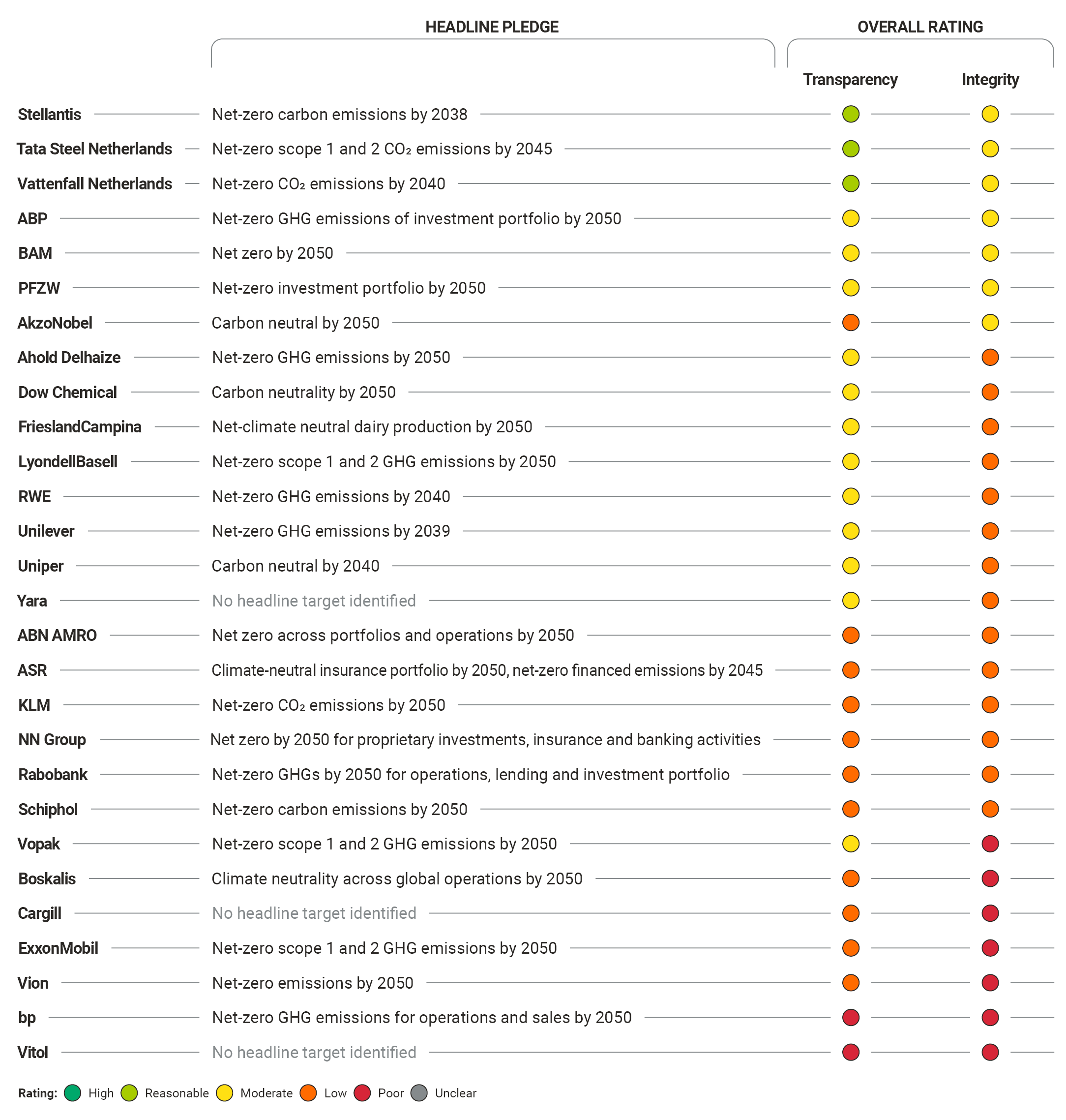 The companies assessed are ABN AMRO, ABP, Ahold Delhaize, AkzoNobel, ASR, BAM, Boskalis, bp, Cargill, Dow Chemical, ExxonMobil, FrieslandCampina, KLM, LyondellBasell, NN Group, PFZW, Rabobank, RWE, Schiphol, Stellantis, Tata Steel Netherlands, Unilever, Uniper, Vattenfall, Vion, Vitol, Vopak and Yara.