
As around 60 countries gather this week in Santa Marta, Colombia, for the ministerial meeting of the First International Conference on Transitioning Away from Fossil Fuels, topping the agenda is turning pledges from willing countries into action.
With the Brazilian COP30 Presidency currently developing the Roadmap for Transitioning Away from Fossil Fuels (TAFF Roadmap), the outcomes of the conference are expected to feed directly into the process. But with its objectives, scope and development process still undefined, the key question is how to design an actionable roadmap.
In the current political climate, the most effective and feasible approach may be to focus on a roadmap championed by a coalition of first-mover countries, according to NewClimate expert Chetna Hareesh Kumar.
“Rather than waiting for global consensus, a coalition approach would bring together a smaller group of willing countries to take the lead on implementation,” she said. “By showing the benefits of the transition, they can build confidence and bring others along.”
This approach reflects rising political uncertainty and an increasingly fragmented geopolitical landscape, where multilateral consensus has become harder to achieve. Resistance from a number of fossil fuel-producing countries and industry actors, alongside continued lobbying to prolong fossil fuel use, has hindered progress towards international agreement on phasing out fossil fuels. This was evident at COP30 last year, which concluded without referencing fossil fuels in its final outcome, despite calls from more than 80 countries for a roadmap to transition away from fossil fuels.
At the same time, the urgency of the transition is growing. Recent energy price shocks triggered by conflicts in the Middle East have exposed the risks of continued fossil fuel dependence. In contrast, countries that have invested in renewable energy and electrification have proven more resilient to such disruptions.
“The second major energy price shock in five years reinforces the case for accelerating the transition,” Kumar said. “Like-minded countries can show leadership by committing to phase out fossil fuel dependence. To support that, they need a concrete roadmap.”
The TAFF Roadmap could take different forms – from a high-level guidance document to legally binding international treaty. In a recent discussion paper, NewClimate experts outline four roadmap options and assess their potential impact and political feasibility. Each option involves trade-offs: more ambitious approaches tend to face stronger political resistance, while more feasible options are less effective in delivering meaningful action.
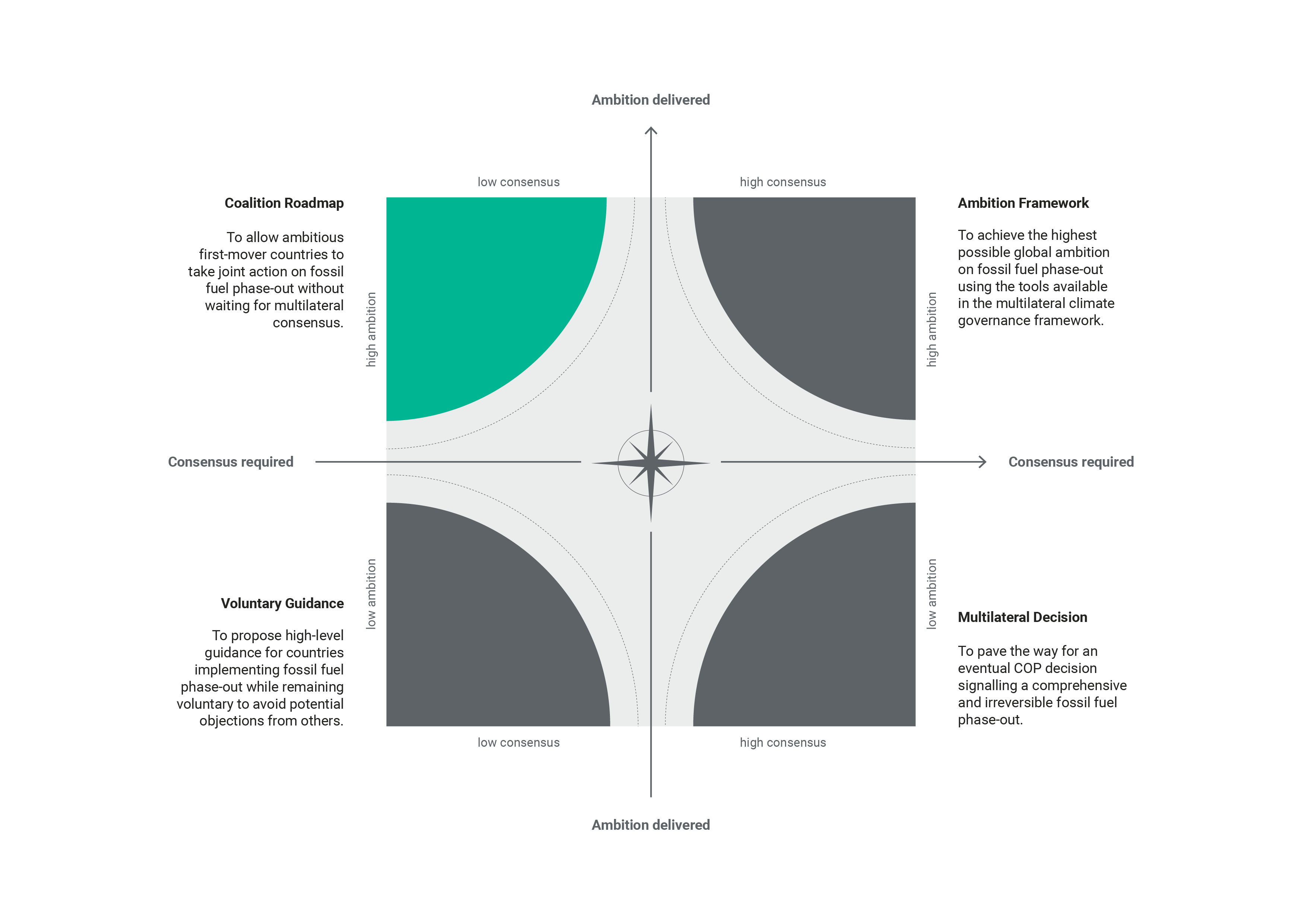
At one end of the spectrum is an ‘Ambition Framework’ – a highly ambitious approach with global phase-out targets and national implementation pathways. While potentially the most effective, it would require a level of consensus that appears difficult to achieve in the current context. At the other end is ‘Voluntary Guidance’, which would be easier to secure support for. However, it is likely to have limited impact in driving meaningful change as countries would not be required to formally endorse or act on it.
Given these trade-offs, the analysis shows that ‘Coalition Roadmap’ is the most promising option to maximise achievable impact.
“The ‘Ambition Framework’ would be ideal in theory, but it is unlikely to be politically achievable right now,” Kumar said. “The ‘Coalition Roadmap’ offers a more practical path, allowing committed countries to move ahead with ambitious implementation.”
Existing initiatives address some elements of the coalition approach, including the Beyond Oil and Gas Alliance and Powering Past Coal Alliance. The TAFF roadmap based on the coalition approach could build on these efforts by bringing different aspects of the transition together under a broader framework, strengthening coordination and reducing fragmentation.
So how could this work in practice?
The COP30 Presidency could launch an implementation-focused roadmap and invite a group of first-mover countries to endorse it and begin taking action. This could be supported by a regular forum to further develop the roadmap and to coordinate international action on shared targets, pathways and policies.
Participating countries would also need to back their commitments with credible national plans to phase out fossil fuels and scale up clean energy.
“A coalition roadmap could send a clear signal to governments and investors that the transition is both feasible and underway, helping to mobilise wider participation and investment,” Kumar said.
Still, key challenges remain. Increasing and channelling climate finance to developing countries, reforming policies like fossil fuel subsidies and addressing international investment rules, such as investor-state dispute settlement clauses that protect fossil fuel investments and constrain government action, will be crucial to enable broader and sustained progress. Delivering on these priorities will require long-term coordination among a wider group of countries, beyond the roadmap and the coalition itself.
“Ultimately, the roadmap is a starting point – but an important one to bring more countries on board and accelerate implementation,” she said. “Alongside it, a dedicated forum is essential to give countries a space to coordinate action.”
Written by Hyunju (Laeticia) Ock, writer and editor at NewClimate Institute.